By Nkeiruka innocent Ekeh
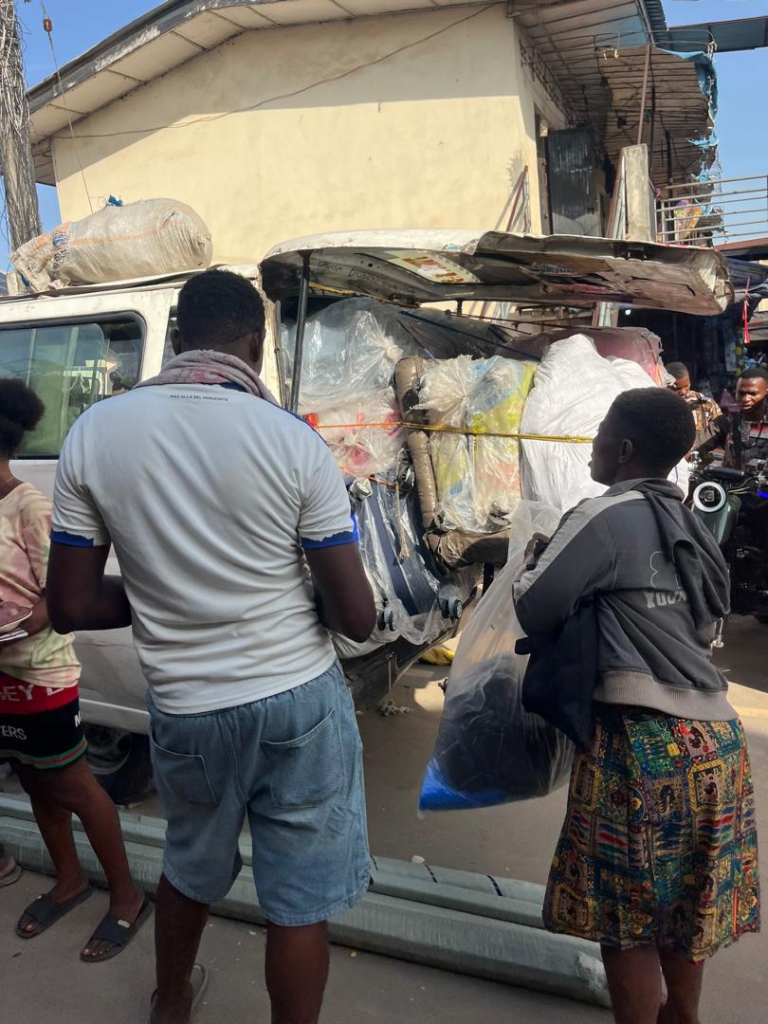
In the dusty lanes of Marine in Port Harcourt’s Main Market, where crates of goods are hastily packed and stacked before being hauled to shops, a grim reality plays out every day: trucks, barrows, and buses are dangerously overloaded, not out of recklessness, but out of desperation to feed their families.
Hundreds of truck and barrow pushers, as well as bus drivers, crowd around retailers, vying to carry all the goods in a single trip so they can “get all the money at once.” With competition fierce, many feel they must accept heavier loads than their bodies or vehicles can safely handle, even when the risks are obvious.

Mr. Chibuike Ani, a truck pusher, explained why his vehicle is routinely overloaded. “It is overloaded in order to meet up with my family’s demands,” he said. “If not so, I will not be able to cope; there are many pushers waiting to deliver, so I have to take it all.”
Malachi Obi, another pusher, admitted that overloading his truck is not easy on his health. “Overloading is not easy for me, but I have to do it to meet up with my responsibilities,” he said. “Most times, when the load is too heavy for me to lift alone, I call for help and pay the person after delivery.”

Mr. Aniagbaoso Amadi, who often carries “heavy duty” loads, revealed that after such work he usually ends up buying painkillers to ease the aches. “After carrying this heavy duty, I will end up buying drugs to alleviate the pains I get from the excess loads,” he said. He described the situation as “penny wise, pound foolish,” pointing out that the money he spends on drugs after delivery cuts deeply into the profit he hoped to make.
Mr. Emeka Obi echoed this sentiment, saying that pushing trucks and barrows is not the kind of job anyone would willingly choose. “Truck/barrow pushing is not the kind of work one would want to engage in, but because of the country we are in, you have to do the available things to eat,” he said. “This country does not care for its citizens, and that is why even graduates settle for menial jobs that are not supposed to be theirs.”
Bus drivers are in a similar dilemma. One driver, who agreed to speak on condition of anonymity, said he is unhappy with the excess goods packed into his bus, knowing they damage parts of the vehicle. Yet, he feels he has no choice. “I don’t have any option other than doing it because I will buy expensive fuel to deliver, feed my family, maintain my vehicle, and still save for unknown circumstances,” he said. “Each trip I go, I go to the mechanic workshop to fix one or two things. I don’t know if I am progressing or retrogressing.”
Residents and safety experts warn that the daily culture of overloading poses serious risks, including accidents and long‑term health problems for workers. However, for many truck pushers, barrow carriers, and drivers in Marine, the alternative going home empty‑handed seems far more dangerous to their families’ survival.
Nkeiruka is of the Ministry of Information, Anambra State
#Ministryofinformation
#Anambraisrising
#Informationiskey
#Solutionishere
#Solutioncontinues