By Maureen Agbala
Anambra State is banking on a major overhaul of its revenue system to raise at least ₦60 billion in internally generated revenue (IGR) next year, with officials emphasizing that taxation will play a central role in funding the state’s ₦757.8 billion 2026 spending plan.
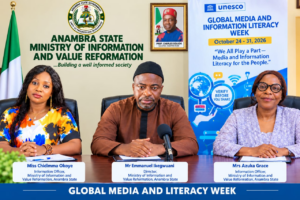
The strategy was unveiled on Tuesday by the Commissioner for Budget and Planning, Chiamaka Nnake, during a post-budget briefing in Awka where she offered a detailed breakdown of Governor Chukwuma Soludo’s newly presented fiscal proposal.
Nnake said the administration is prioritizing “aggressive but technology-led” revenue expansion, warning that the era of poor IGR performance must end if the state expects to deliver its ambitious capital projects.

“For years, our IGR outcomes have fallen below budgeted targets and well below our real potential,” she said. “The 2026 budget demands a more efficient system, one that blocks leakages, captures more eligible taxpayers, and widens the net through technology.”
She explained that Anambra is projecting ₦72 billion from IGR, out of which ₦60 billion is expected to come from direct internal sources, with taxation being a key driver. According to her, tax reforms would not raise rates arbitrarily but focus on digitalisation, fairness, and compliance.
No Borrowing for Recurrent Spending
Reiterating the governor’s fiscal rule, Nnake clarified that the state would not turn to loans to pay for overheads or routine government consumption.

“Borrowing will be limited strictly to commercially viable projects that can pay themselves back,” she said. “We are not committing Anambra to debts that do not support economic growth.”
The commissioner noted that the state ended last year with a ₦135 billion deficit, which underscores the urgency of strengthening the revenue base. She added that the 2026 budget aims to eliminate structural weaknesses in the current collection system.
Big Budget, Bigger Capital Focus
The 2026 proposal, tagged “Changing Gears 3.0: Solution Continues,” channels 79 percent of total spending into capital development. Soludo allocated ₦595.3 billion to infrastructure, economic expansion, urban renewal, and environmental resilience, leaving ₦161.6 billion, or 21 percent. for recurrent obligations.

Sector-by-sector growth shows a sharp uptick in investment :
Economic sector: +27%
Infrastructure: +27.7%
Health: +12.2%
Administrative sector: +12.5%
Environment: +138.8% — the highest increase
Among the key projects for 2026 are Awka 2.0, a new market development initiative, a housing project, land acquisition schemes, and major upgrades across urban centres.
“Our budget performance stood at 61 percent by the end of October,” Nnake said. “With dry season acceleration, we expect to hit 75 percent before the year closes. That momentum is what we are carrying into 2026.”
Soludo: ‘Every Kobo Will Have Value’
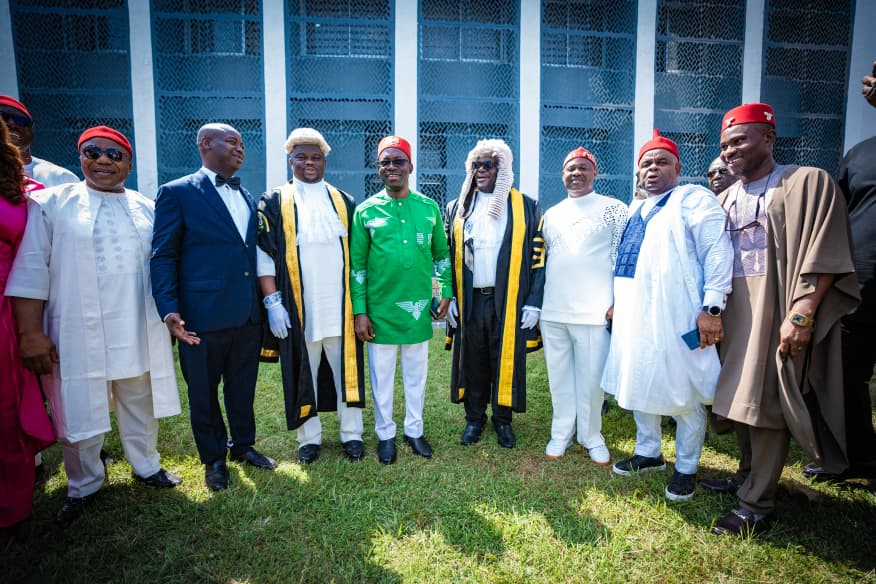
Presenting the spending plan to the House of Assembly earlier, Governor Soludo said the proposal represents a 24.1 percent increase over the ₦606.99 billion budget for 2025, a difference of ₦151 billion.

He said the bump is a deliberate push to scale up infrastructure delivery, despite the pressures of an election year.
“We remained focused in 2025 and achieved more than 60 percent performance,” the governor told lawmakers. “This new budget enables us to accelerate the transformation of Anambra into the liveable, prosperous homeland we envision. Every kobo will be applied with utmost prudence.”
Soludo acknowledged a ₦225.7 billion deficit, but said it would be financed through a mix of improved IGR, concession agreements, structured partnerships, and responsible facility-backed borrowing.
Lawmakers Pledge Speedy Work
House Speaker Somtochukwu Udeze praised the administration for what he described as “visible, undeniable transformation projects” across the state. He assured that lawmakers will subject the budget to thorough but accelerated scrutiny.
“This is a serious proposal, and we will give it the serious attention it deserves,” he said.
The 2026 budget cycle is expected to be the administration’s most ambitious yet, driven by a revenue system that the government insists must evolve, quickly and decisively.