By Chizoba Njaka
The international community commemorates June 12 annually as the World Day Against Child Labour, a global observance dedicated to raising awareness of the challenges faced by children engaged in labour and mobilizing coordinated efforts toward the eradication of such practices.
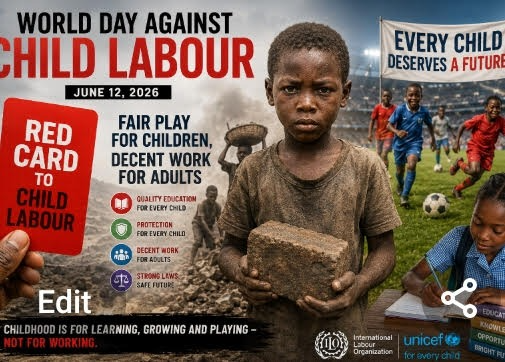
The 2026 commemoration, themed “Red Card to Child Labour: Fair Play for Children, Decent Work for Adults,” underscores the urgent need for renewed commitment and strengthened collaboration to eliminate child labour and protect children from all forms of exploitation globally.
Led by the International Labour Organization (ILO) and the United Nations Children’s Fund (UNICEF), the campaign emphasizes the collective responsibility of governments, employers’ associations, workers’ organizations, and civil society in reinforcing measures that safeguard children’s rights. Central to this effort is the assurance of access to quality education, adequate protection, and opportunities for comprehensive development.
Recent global estimates indicate that approximately 138 million children are still engaged in child labour, with about 54 million involved in hazardous work that poses serious risks to their health, safety, and overall well-being. Despite notable progress, including a reduction of over 22 million children in child labour since 2020, the global target of eliminating child labour by 2025 has not been achieved.
In Nigeria, child labour remains a pressing socio-economic concern, largely driven by poverty, unemployment, economic hardship, and limited access to quality education. Many children are engaged in agriculture, mining, street hawking, domestic work, and other informal economic activities.
According to the ILO, nearly one-third of children engaged in child labour are out of school, while many others struggle to combine work with education, often resulting in poor academic performance and increased dropout rates.
Experts emphasize that sustainable progress in eliminating child labour requires addressing its root causes. They recommend increased investment in quality education, expansion of social protection programmes for vulnerable households, creation of decent employment opportunities for adults, and stricter enforcement of child protection and labour laws.
The private sector has also been called upon to ensure that business operations and supply chains are free from child labour and comply with responsible labour practices and international standards.
The 2026 campaign adopts the symbolism of a football red card to deliver a clear message that child labour is unacceptable and must be eradicated. Stakeholders maintain that every child deserves the opportunity to learn, develop, and play in a safe environment, rather than being compelled to work for survival.
As the world observes this occasion, advocates continue to call for strengthened partnerships and collective action to uphold the rights of children and secure a future in which every child can fully realize their potential.
Chizoba Njaka is of the Ministry of Information, Anambra State
#Ministryofinformation
#Anambraisrising
#Informationiskey
#Solutionishere
#Solutioncontinues
🇳🇬
Official website of the Government of Anambra State
Here's how you know
🏛️
Official government websites
A .gov.ng is an official Nigerian government website managed by authorised government institutions.
🔒
Secure websites use HTTPS
A padlock icon and https:// means your connection is encrypted and secure.
- News & Media
- Citizen Engagement
- Projects
- Grievance Redress
- Contact Us