By Regina Igwebuike
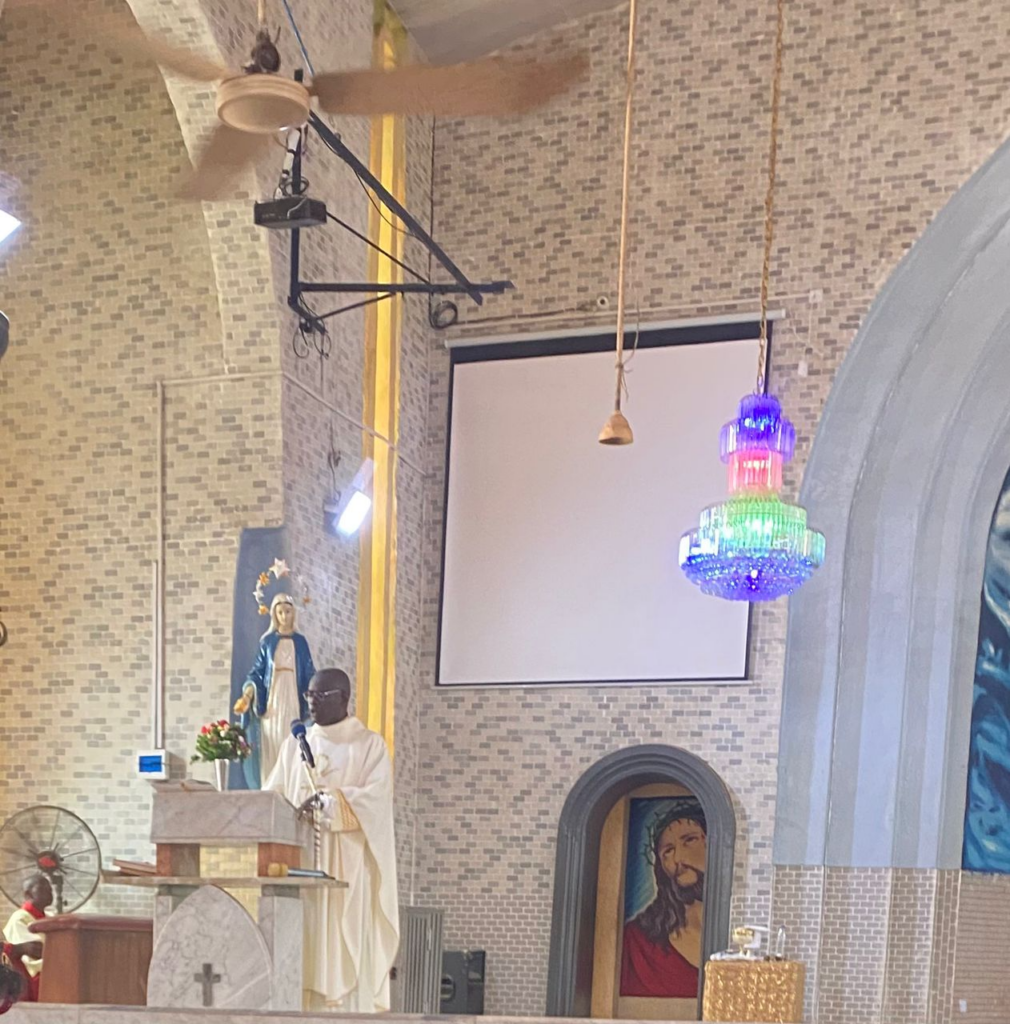
Rev. Fr. Cyprian Ezeakunne, priest resident at St. Matthew’s Catholic Church, Amawbia, Awka South LGA, has called on Christians to model their lives after the Holy Trinity by embracing unity, dialogue, and fraternal charity in a world marked by division.
In his homily today, May 31 during Holy Trinity Sunday Mass, Fr. Ezeakunne described the doctrine of the Most Holy Trinity as one of the central dogmas of the Catholic Church. He explained that the Trinity reveals God as He truly is: “One God in three divine Persons — Father, Son, and Holy Spirit.”
“The Trinity is not just a doctrine on paper. It is God acting in history. It is God revealing Himself to Israel, God entering our world as Jesus the carpenter who died and rose to save us, and God descending as the Holy Spirit at Pentecost to share life with the Church and mankind.”
Drawing lessons for daily living, the cleric said the solemnity teaches that sincere communication is possible, solidarity is necessary despite differences, and humanity is saved through love and concern for one another.
Quoting Acts 17:28, Fr. Ezeakunne reminded the faithful that “we live in the Trinity, we move and have our being in the Trinity.” He noted that the three Persons of God never work in isolation, just as the different parts of the human body function together in unity.
“If one part decides not to work, the whole body suffers. Whatever we do, we must ask: does it affect others positively or negatively?”
The cleric linked the mystery of the Trinity to Nigeria’s national life, citing the country’s three major ethnic groups and the three arms of government. “They are meant to work together for the good of all. Disunity begins when one thinks he is bigger than the others,” he cautioned.
Fr. Ezeakunne urged Catholics to respect themselves and others because “every person is a temple of the Holy Spirit where the Father, Son, and Holy Spirit abide.” He said Christians must hold firmly to the conviction that the Trinitarian God is the source of hope, courage, strength, and their final destination.
“Let us practice Trinitarian love in our families — father, mother, and children, because through Baptism we become children of God and members of God’s Trinitarian family. Let us live the I–God–my neighbor relationship by loving God and loving our neighbor.”
Regina is of the Ministry of Information, Anambra State