BY AMAECHINA ANTHONIA .
The world stands still to observe one of the most critical but often overlooked global health days – World Patient Safety Day.
On 17th September,
Established by the World Health Assembly in 2019, this day reminds us of the most fundamental principle of medicine: First, do no harm.
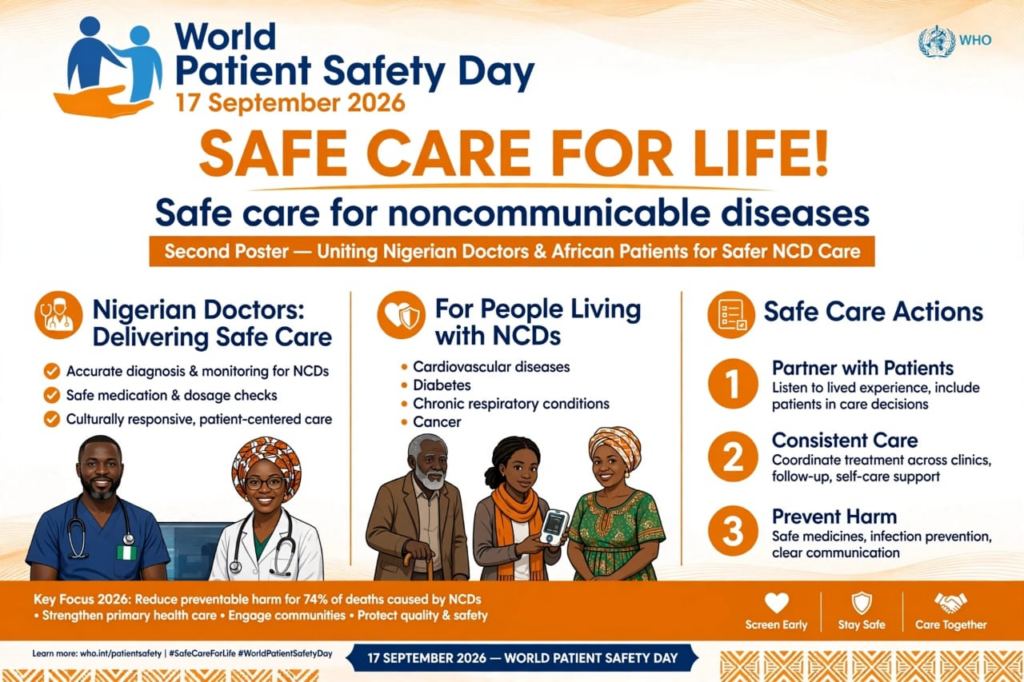
This year, the World Health Organization has chosen a theme that touches almost every family in Nigeria and around the world: “Safe care for noncommunicable diseases,” with the powerful slogan “Safe care for life!” It is a call that cannot come at a better time.
Noncommunicable diseases, or NCDs, are no longer diseases of the rich. They are heart disease, stroke, diabetes, cancer, hypertension and chronic lung diseases. They are responsible for three out of every four deaths globally, about 43 million deaths every year.
The danger is not just the disease itself, but the care. WHO data shows that one in ten patients is harmed while receiving hospital care, and half of these harms are preventable.
For a person living with diabetes or cancer who visits a hospital ten, twenty times in a year, that risk multiplies. A wrong dosage, a delayed diagnosis, a misread lab result, or poor coordination between doctors can cost a life.
That is why the 2026 campaign focuses on the entire journey of care – from prevention, screening and accurate diagnosis, to treatment, self-care, rehabilitation and palliative care.
It insists that safety must not be an event that happens only inside the theater, but a continuum that follows the patient for life.
To achieve this, WHO is calling for five urgent actions. First, we must treat patients not as mere recipients, but as partners who have lived experience.
Second, we must strengthen prevention and early risk assessment. Third, we must ensure early and accurate diagnosis.
For Nigeria, this message is deeply relevant. Our primary health care system, which is the first point of contact for most people with hypertension and diabetes, must be empowered to deliver safe, coordinated care.
Health workers must be supported with training, and patients must be educated to ask questions, keep their drug records, and speak up.
Anthonia is of the Ministry of information and Value Reformation, Anambra State.
#WorldPatientDay2026
#NCDs
#InformationIsKey