By Grace Onwukwe
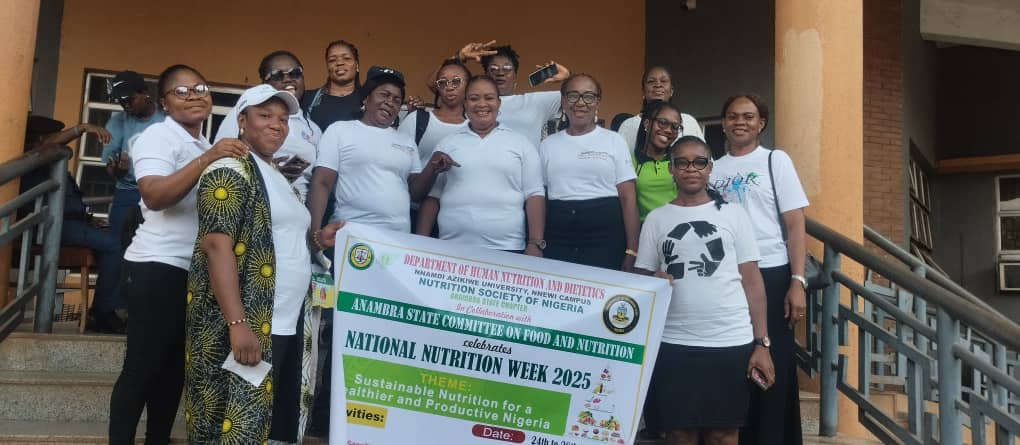
Nutrition stakeholders in Anambra State have joined their counterparts nationwide to commemorate the 2025 National Nutrition Week, themed “Sustainable Nutrition for a Healthier and Productive Nigeria.”
The event, organised by the Department of Human Nutrition and Dietetics, Nnamdi Azikiwe University (UNIZIK), Awka, in collaboration with the Nutrition Society of Nigeria and the Anambra State Committee on Food and Nutrition, commenced on November 24 with a sensitization programme at UNIZIK 94.1 FM.

During the radio sensitization, topics such as “Overview of Nutrition as a Field of Study,” “Theme and Objectives of the 2025 National Nutrition Week,” and other scheduled activities were discussed by Dr. Justina N. Okoli. Other speakers included Dr. Okoye who spoke on “Adequate Nutrition for All Ages,” Dr. Obidiozor on “Consequences of Poor Nutrition,” Mrs. Nwoke on “Diabetes Mellitus Management,” and Dr. Rose Amasiani on “Issues on Improving Nutritional Status especially involving Policy on Food and Nutrition.”
Activities lined up for the week included a “Walk for Life,” as well as sensitization visits to selected health facilities and schools.

Speaking before the walk on November 26, the Permanent Secretary, Ministry of Budget and Economic Planning (MoB&EP), Mrs. Chinyere Nwabachili who also serves as Chairperson of the Anambra State Committee on Food and Nutrition emphasized the importance of regular exercise and the consumption of indigenous foods. Representing the Commissioner for Budget and Economic Planning, Mrs. Chiamaka Nnake, she highlighted the role of these practices in preventing diseases such as anaemia, reducing mortality and morbidity rates, promoting healthy living, and supporting sustainable development.
She urged participants to advocate for the consumption of safe, indigenous foods, describing them as rich, healthy, and medicinal.
“Let us tell our people to leave additives and cosmetic foods and return to our indigenous foods. These foods help us grow healthy and build the nation’s wellbeing,” she said.
The walk for life, led by the State Nutrition Officer, Dr. Rose Amasiani, covered Secretariat Road, Emeka Anyaoku Boulevard, Solution BusTerminal, and Aroma Junction. Participants sensitized residents, distributed fliers, and encouraged the public to exercise regularly, eat nutritiously, and maintain healthy lifestyles.
Delivering a lecture titled “Back to Our Roots: Indigenous Foods, Nutrition and Sustainability,” Dr. Justina N. Okoli, Head of the Department of Human Nutrition and Dietetics, NAU described indigenous foods as traditional foods originating from specific communities, tied to culture, environment and history. She noted that these foods are usually natural, locally sourced, and prepared using traditional methods passed down through generations. According to her, indigenous foods are nutrient-dense and contain vitamins and antioxidants that support cellular health.
Dr. Okoli explained that sustainable nutrition promotes diets that are healthy, culturally acceptable, accessible, affordable and environmentally friendly. She added that integrating indigenous foods into daily diets contributes to wellness, cultural preservation, and sustainable development.
She listed examples of indigenous foods to include millet, sorghum, yam, cocoyam, fluted pumpkin leaves, bitter leaf, okra, snails, bushmeat and fish. She expressed concern that modernization and globalization have shifted many communities toward processed foods, resulting in rising rates of malnutrition, obesity and diet-related diseases. Returning to indigenous foods, she said, helps address these health issues while preserving biodiversity and strengthening food sovereignty.
The nutrition expert emphasized the need for proper preservation and preparation methods to retain food nutrients and prevent foodborne illnesses. She noted that indigenous foods contribute significantly to national development across health, economy, food security, education, social and cultural development, policy and governance and environmental sustainability.
Grace is of the Ministry of Information, Anambra State