By Stanley Onunkwor
The Anambra State Commissioner for Environment, Dr. Clem Aguiyi, has called for stronger regional and national commitment to disaster prevention, preparedness and community resilience, stressing that proactive interventions must complement emergency relief efforts to protect lives, livelihoods and critical infrastructure.
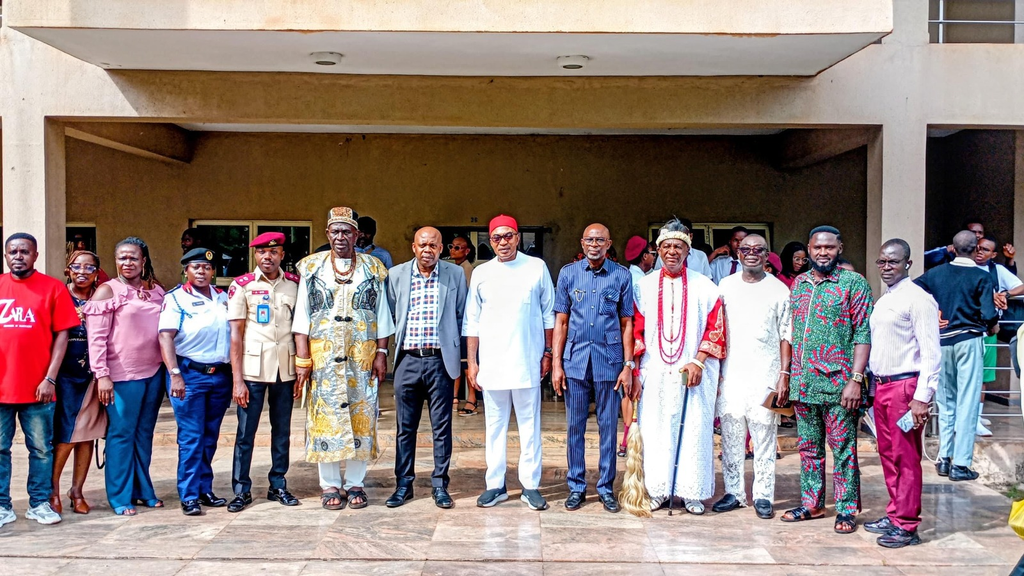
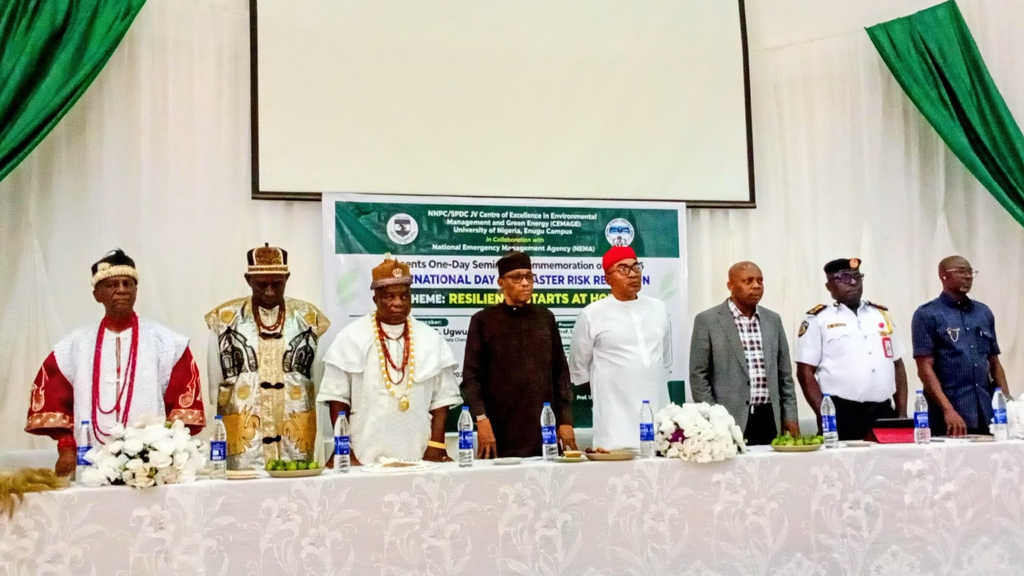
Dr. Aguiyi made the call on October 13 in Enugu while delivering a guest lecture at the 2026 commemoration of the International Day for Disaster Risk Reduction, organised by the NNPC/SPDC Joint Venture Centre of Excellence at the University of Nigeria, Enugu Campus (UNEC).

Speaking on the theme, “Resilience Starts at Home,” the Commissioner urged governments, institutions and communities to prioritise disaster risk reduction, warning that preventable disasters continue to impose significant human, social and economic costs on vulnerable populations.
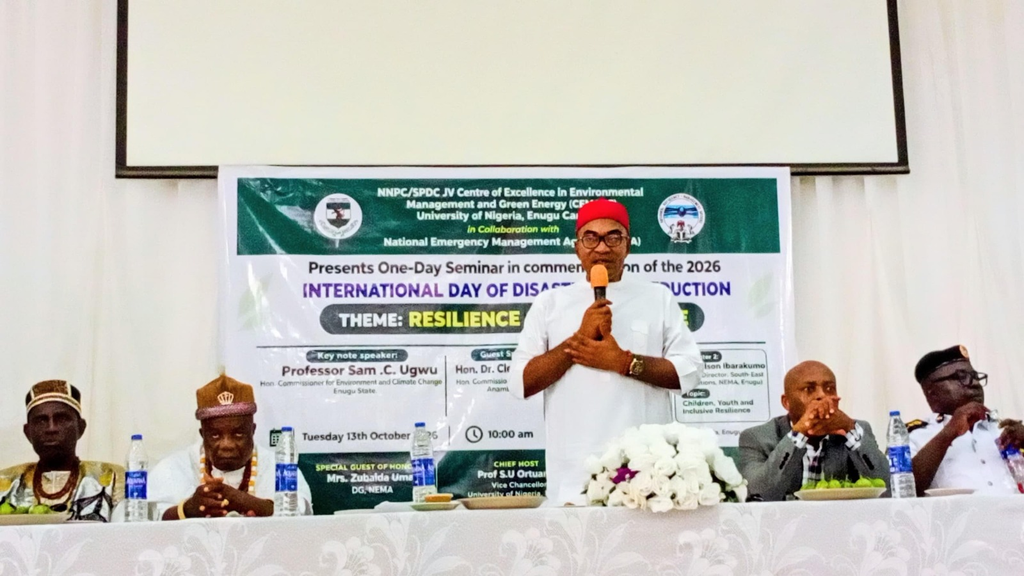
“Disaster does not send invitation,” he said, underscoring the need for advance planning, public awareness and collective responsibility in reducing the impact of emergencies.

Highlighting the scale of environmental and human-induced hazards across Enugu, Ebonyi and Anambra States, Aguiyi presented examples of how inadequate preparedness and delayed interventions have exposed communities to serious risks.
In Enugu State, he cited more than 100 active gully erosion sites across Udi, Ezeagu and Nkanu East, noting that the Ngwo gully had divided a community and forced schoolchildren to trek approximately five kilometres to access their school.
He also drew attention to deteriorating abandoned coal tunnels in Iva Valley, Ogbete and Okpara Mine, warning that their reported deterioration and the emergence of sinkholes posed potential risks to public safety.
The Commissioner further recalled that Ogbete Main Market had suffered two major fire incidents within five years, resulting in losses exceeding ₦2 billion for traders. He attributed the scale of the losses to inadequate functional firefighting infrastructure, reinforcing his argument for stronger emergency-response capacity.
Turning to Anambra State, Dr. Aguiyi described the erosion crisis as particularly severe, citing more than 1,000 erosion sites and estimating that gullies had encumbered approximately 35 per cent of the state’s 4,877-square-kilometre landmass.
He expressed concern that while other urban centres continued to expand through ambitious land-development projects, erosion was steadily consuming valuable land and threatening communities, infrastructure and economic activities in Anambra.
According to him, the scale of the crisis demands sustained government attention, stronger institutional coordination and increased investment in preventive measures rather than reliance on interventions after disasters have occurred.
In Ebonyi State, the Commissioner highlighted public-safety and environmental concerns associated with lead-zinc mining pits in Abakaliki and Enyigba, particularly the potential contamination of drinking-water sources.
He recalled the 2021 collapse of a mining pit in Ezza South, which reportedly buried four young miners, and cited figures from the National Emergency Management Agency (NEMA) indicating that more than 12,000 people were displaced by flooding in Afikpo South, Ikwo and Abakaliki in the previous year, without insurance coverage.
He also referenced the displacement of more than 20,000 people during the communal conflict between Effium and Ezza-Effium, illustrating the need for disaster preparedness frameworks that address both environmental hazards and human-induced emergencies.
“These examples underline the importance of strengthening prevention, preparedness and coordinated responses to both environmental and human-induced hazards,” he said.
To address the challenges, Dr. Aguiyi advocated a comprehensive disaster-management framework that places greater emphasis on prevention and preparedness while strengthening existing relief and recovery mechanisms.
While acknowledging the contributions of NEMA and other emergency-management agencies, he maintained that the scale and complexity of Nigeria’s disaster risks require stronger institutional capacity, adequate funding and effective community-based response systems.
He proposed a five-level resilience framework covering households, communities, schools, local governments and the national government.
At the household level, he urged families to acquire basic fire extinguishers and develop essential emergency-response skills, including cardiopulmonary resuscitation (CPR), to improve their ability to respond to emergencies before professional assistance arrives.
At the community level, he recommended the use of traditional town criers, sirens and Igbo-language WhatsApp groups to disseminate early warnings and ensure that vital safety information reaches residents quickly.
For educational institutions, he advocated the introduction of compulsory Disaster Risk Reduction courses in universities and the establishment of disaster preparedness clubs in secondary schools to equip young people with practical knowledge of risk prevention and emergency response.
At the local government level, he proposed that five per cent of monthly allocations be dedicated to erosion control and the acquisition of emergency-response equipment.
At the national level, he called for disaster-risk insurance schemes targeting vulnerable farmers and other exposed populations, arguing that financial protection must form an essential part of the country’s disaster-management strategy.
Dr. Aguiyi also invited the NNPC/SPDC Joint Venture Centre of Excellence to consider adopting selected disaster-prone locations as Community Resilience Laboratories for practical research, community preparedness and targeted interventions.
The proposed locations include a gully erosion site in Ngwo, a mining community in Ebonyi State and an erosion-affected site in Anambra State.
He explained that the initiative would provide opportunities for research institutions, government agencies, host communities and corporate organisations to collaborate on developing practical, locally appropriate solutions to persistent environmental and safety challenges.
Emphasising the relationship between corporate environmental responsibility and community protection, the Commissioner said: “If oil can pollute a community, oil money should insure that community.”
He stressed that communities exposed to environmental risks should benefit from stronger protection mechanisms, adequate preparedness measures and sustainable interventions capable of reducing their vulnerability to disasters.
He recounted an emotional experience from the 2022 floods in Anambra State, recalling a woman stranded on the rooftop of her house in Anambra East who refused to abandon a bag containing her children’s school certificates.
According to him, the woman’s determination to preserve the documents represented the importance of hope, family responsibility and preparedness in the face of adversity.
“She lost her house, but she refused to lose her future. That is what resilience starts at home means. Home is not just building. Home is hope,” he said.
The Commissioner maintained that genuine resilience goes beyond rebuilding damaged structures after a disaster to ensuring that individuals, families and communities possess the knowledge, resources and support systems needed to withstand emergencies and recover from their effects.
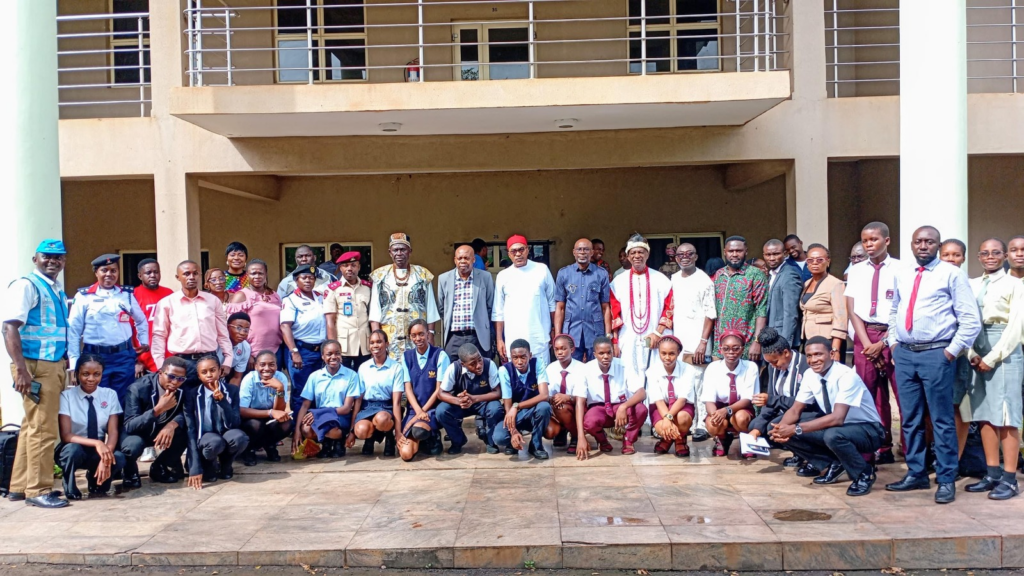
The event was attended by the Director of the NNPC/SPDC Joint Venture Centre of Excellence, a representative of the Director-General of NEMA, service commanders and students of the University of Nigeria, Enugu Campus.
The commemoration provided a platform for stakeholders to reflect on disaster risks in the South-East and the urgent need to strengthen preventive measures, early-warning systems, institutional partnerships and community-level preparedness.
Stanley Onunkwor is of the Ministry of Information and Value Reformation, Anambra State
#Anambraisrising
#Solutioncontinues
#Solutionisthekey