By Obianuju Azukaego
The global media space is increasingly in need of a balanced and accurate reportage in the dissemination of information to the public.
In line with this need, the Nigeria Union of Journalists (NUJ), Anambra State Council, Information Chapel, serving as a critical bridge between government and the masses organised a comprehensive training conference tagged “Opportunities Available to Anambra State Information Officers in a Digital World”.

The programme brought together government and private-sector dignitaries, alongside seasoned resource persons, who equipped Information Officers with the knowledge and skills required to discharge their duties professionally in a rapidly evolving digital environment.
The conference was organised by the NUJ Information Chapel, led by Dr. Stanley Onunkwor, in collaboration with the Chapel’s Welfare Association chaired by Mr. Kennedy Aniedozie. It held at the Head of Service (HOS) Conference Hall, Jerome Udorji Secretariat, Awka.

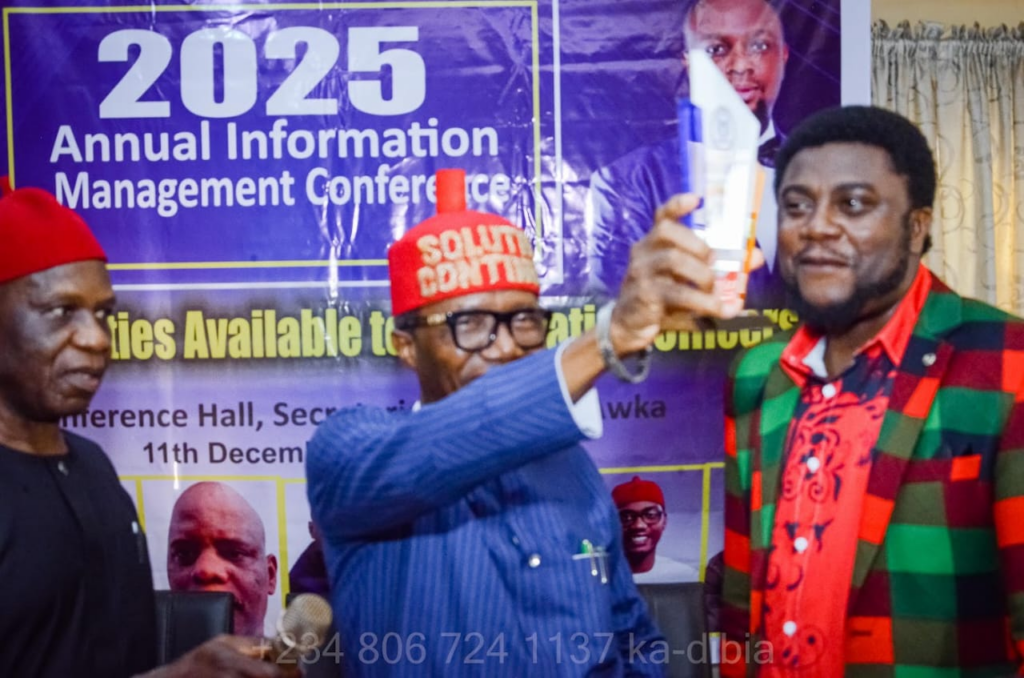
The gathering of information stakeholders also featured a send-off ceremony for outgoing Permanent Secretary of the Ministry, Barr. Mrs. Ndirika Onyekwelu, and a retired staff, Pst. Mrs. Uche Kalu. In addition, awards were conferred on selected information management stakeholders, among whom was the Commissioner for Information, Chief Law Mefor, PhD.
In his remarks, Mefor noted that journalists are the only professionals explicitly captured and recognised in the Nigerian Constitution. He said that, as members of the Fourth Estate of the Realm, journalists and Information Officers serve as the voice of the voiceless, bearing the delicate responsibility of reporting government policies while also defending the interests of the masses.

He urged information officers to work diligently to acquire the necessary tools to properly inform and educate the public, especially at a time when the social media space is saturated with misinformation and requires facts and verified content.
The dynamic commissioner thanked the NUJ Information Chapel for the award for excellence leadership conferred on him and pledged to continue upholding hard work and professionalism.

Delivering the keynote address, a former Commissioner for Information, Culture and Tourism in the state, Chief Tony Onyima, PhD, described the conference as timely, given the unprecedented technological disruptions that have reshaped the gathering, flow, character, and consequences of information. According to him, these disruptions have made information management more dynamic, complex, and burdensome.
“Today, we inhabit in a world where rumours outrun official statements, where a 15-second TikTok clip can overshadow a four-page press release, and where citizens retrieve breaking news from their smartphones long before it reaches radio or television,” he stressed.
To address the challenges confronting factual and accurate information in the current environment, Onyima charged information officers to uphold the voice of government by shaping public image and effectively disseminating vital information.
“We stand at the threshold of the greatest era of opportunity ever available to government information officers. Therefore, my task this morning is to help illuminate those opportunities and to challenge you to embrace them.
“In today’s world, content is the new currency, but storytelling is the vault that gives it value. The role of an information officer is no longer merely to “announce” government projects. It is to craft compelling, human-centred stories that explain why policies matter.”
Former Commissioner Onyima emphasised that professional information officers must be interested in the human angle of every story or report. He outlined practical approaches, including:
Producing 60–90-second explainer videos for X, Facebook, Instagram, and TikTok; Highlighting human angles, such as “How a new borehole changed Nneka’s business” rather than “Government commissioned a borehole; and Using metaphors as well as everyday imagery to make policies relatable.
He further tasked the officers with embracing data-driven communication, transforming messaging from guesswork to strategy and enhancing credibility.
Onyima enjoined them to leverage available digital opportunities, including: Livestreaming press briefings and government events; Running real-time Q&A sessions with citizens; Deploying rapid WhatsApp or Telegram information channels; and Using social listening tools to detect, verify, and debunk rumours quickly.
They were also encouraged to build personal branding as a means of attracting and sustaining public trust.
“Today, people trust faces, not institutions. Information officers must cultivate a credible, professional public identity. Citizens engage more readily with familiar human voices. Officers become subject-matter references, not anonymous desk officers. Trust grows when communication is transparent and personal.”
He called on information officers to imbibe the following practices: Developing a clean, professional social media presence; Sharing behind-the-scenes processes that humanise government work; Maintaining neutrality and avoiding partisan commentary as well as Modelling clarity and accuracy at all times.
The former commissioner noted that, to lead effectively, every information officer must become: A storyteller who humanises governance; Strategist, who uses data to shape communication; Digital diplomat, who engages citizens with empathy; Curator of truth in an age of misinformation and a lifelong learner committed to continuous evolution.
He further urged information officers to view Artificial Intelligence (AI) as a colleague rather than a threat, citing its capacity to enhance efficiency and effectiveness in information management.
“The tools are here, the opportunities are vast, the responsibility is enormous. And the moment is now”, he said.
In another paper presentation titled “Evolving Roles and Opportunities of Information Officers in Governance and Beyond the Job,” the Managing Director of the Anambra State Civil and Social Reformation Office (ANCISRO), Sir Chuka Nnabuife, highlighted the vital role of information officers in translating policies into messages that the public can understand, believe, and act upon.
He underscored the importance of information officers thriving under the Anambra State Government’s commitment to transparency, accountability, and citizen engagement as pillars of good governance.
Sir Nnabuife noted that information pfficers are no longer mere spokespersons but strategic professionals responsible for brand reputation management and crisis response coordination.
“We are in the era defined by rapid technological shift. Instant information transfer and an increasingly fragmented communication environment.”
He added that information officers now own the responsibility of managing public relations, public policy communication, institutional reputation, and digital narratives. According to him, they must master effective communication and develop voices capable of influencing positive change.
He identified key skills required of information officers to include crisis management, media training, and strategic communication. He further noted that opportunities abound for them in academia, mentorship, advisory roles to communities and faith-based organisations, information consultancy, policy analysis, and other viable fields.
Describing nformation officers as custodians of a powerful currency that shapes governance and global interaction, Sir Nnabuife stressed their capacity to inspire, educate, and transform society.
The outgoing Permanent Secretary of the Ministry, Barr. Mrs. Ndirika Onyekwelu underscored the benefits of the training and urged information officers to take the advantage of the training to improve in their duties.
Also in his remarks, the former Director of Information and Chairman of NUJ, State Information Chapel, Sir. Tony Nweke, stressed the need for continuous capacity building of the officers to improve service delivery, emphasizing that human capital development is the best exercise to improve manpower.
In his vote of thanks, the Acting Director of the Ministry, Mr. Emmanuel .U.Emmanuel commended the resource persons and other dignitaries for adding great value to the conference.
He, however, charged the participants to utilise the wealth of knowledge got from the conference to thrive in their responsibilities.
In his remarks, the Chairman of NUJ, Anambra State Council, Odogwu Emeka Odogwu, PhD, charged information officers to maximise the platforms available to them and elevate their professional roles to enviable heights. He commended the Information Chapel for organising what he described as a timely and impactful conference.
Earlier in his welcome address, the Chairman of the NUJ Information Chapel, Dr. Stanley Onunkwor, explained that the Information Management Conference was organised to redirect and reposition information officers in Anambra State to their rightful place as mediators between government and the masses. He commended the award recipients for their outstanding contributions to information management as well as their respective fields.
Dr. Onunkwor also expressed gratitude to the resource persons and dignitaries who graced the occasion.
The high point of the programme was the conferment of awards on stakeholders who distinguished themselves in their various endeavours. Among the award recipients were Dr. Law Mefor, who received the Award for Excellent Leadership; Dr. Nwabufo Nwankwo, who received the Outstanding Permanent Secretary Award; Dr. Chibeze Oforbuike, Mayor of Aguata, who clinched the Good Governance Award; Hon. Romanus Ibekwe, Mayor of Anaocha, who received the Security Management Award; and Dr. Smart Okafor, MD/CEO of ReapFold Properties Ltd, who received the Champion of Journalism Award.
Azukaego is of the Ministry of Information, Anambra State