By Chinyere Nwoye
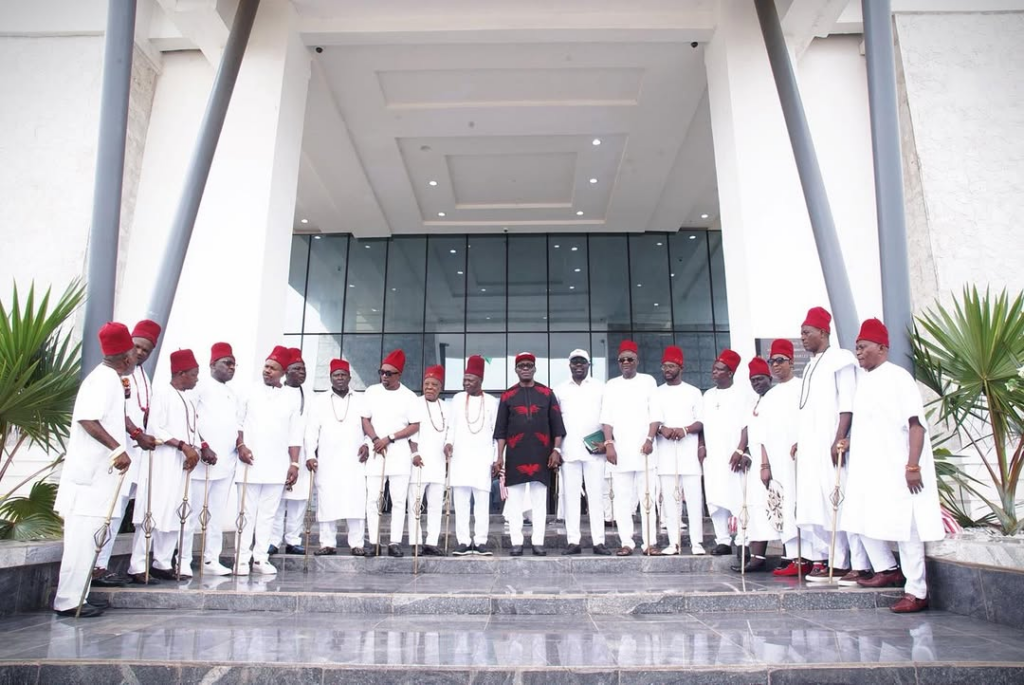
Anambra State Governor, Prof. Charles Soludo, has met with the Ozo Awka Society, reaffirming his administration’s commitment to transforming Awka into a world-class mega city while calling on traditional title holders to remain unwavering voices for truth, peace, and community cohesion.
The meeting, which was well attended by Ndi-Ozo title holders, was led on the side of the society by Ozo Sir Chukwujekwu Eze.

Addressing the gathering, Governor Soludo acknowledged that Awka had for decades suffered a deficit of infrastructure and vision unbefitting of a state capital, but struck an optimistic note, asserting that the tide was turning.
“The narrative is gradually changing through ongoing projects and investments across the city,” he said.

The Governor pointed to a series of landmark achievements as evidence of that change, including the establishment of a functional Government House in Awka, a promise, he noted, his administration had kept. He described the Light House complex and other ongoing infrastructural interventions as tangible symbols of a new Anambra rising.
He further highlighted the development of Solution Fun City as a deliberate strategy to reposition Awka, not merely as a transit corridor, but as a destination city in its own right.

Yet the Governor was clear that steel and concrete alone would not build the city he envisions. “Physical infrastructure alone cannot build a 21st-century city,” he said. “The importance of people, leadership, and community participation in the development process is paramount.”
Turning to the protracted traditional leadership dispute over the Eze Uzu stool of Awka, Governor Soludo struck a firm but measured tone. He stated that his administration would not be swayed by sentiment, and that governance demands the courage to make difficult decisions.
“The law is the law,” he said. “Leadership requires doing the uncomfortable things.”
He directed stakeholders to await the findings of the Commission of Enquiry he constituted to resolve the matter, insisting that due process and the community’s established zoning arrangement must be respected and upheld.
The Governor then issued a broader charge to the Ndi-Ozo and community leaders, urging them to be consistent agents of truth and reconciliation wherever they find themselves. Drawing on a telling precedent, he expressed confidence that lasting peace in Awka was achievable “just as it was done in Isuofia after years of crisis.”
The gathering closed with renewed calls for unity, development, and respect for traditional institutions both in Awka and across Anambra State.
Chinyere writes for the Anambra State Ministry of Information.